
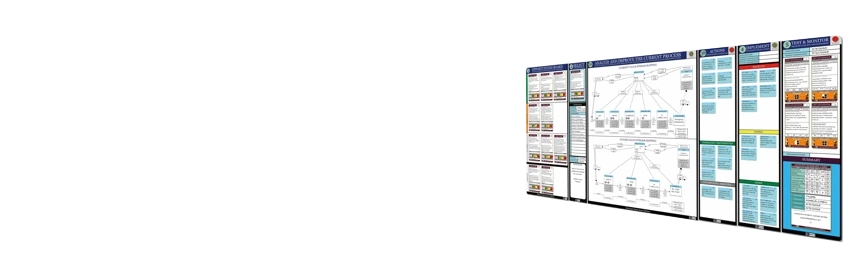
If you’re planning a Kaizen event and want to avoid the usual chaos, this free Kaizen Event Starter Kit gives you a clear structure, ready-to-use templates, and a simple step-by-step flow your team can follow.
Get the kit here: https://pmxboard.com/resources-kaizen-event-starter-kit
What is the Kaizen Event Starter Kit?
The Kaizen Event Starter Kit (PDF) is a practical toolkit designed to help teams run a focused improvement event in 1–3 days. Instead of starting from a blank page, you’ll use proven, facilitation-friendly materials to define the problem, analyze root causes, prioritize countermeasures, build an action plan, and set up follow-up tracking.
What’s inside the kit (and why it matters)
- Kaizen agenda + roles checklist — a simple flow that keeps the event on time and prevents “meeting drift.”
- Data capture + root-cause prompts — structured questions and fields that guide teams toward facts and causes (not opinions).
- Action plan structure to keep momentum after the event — so improvements don’t stall after day 3.
Free download: Access the Kaizen Event Starter Kit (PDF) here → https://pmxboard.com/resources-kaizen-event-starter-kit
How to run a 1–3 day Kaizen event using the kit
Step 1: Define the problem clearly (and narrow the scope)
Kaizen events fail most often due to scope creep. Before the team jumps into brainstorming, use the kit to clarify:
- What process / area is in scope (and what is not)
- What “good” looks like (target condition)
- What will be measured (quality, cost, delivery, time, safety)
Tip: If you can’t explain the problem in one sentence, the event is too broad.
Step 2: Capture the current state with facts
Instead of “what we think is happening,” gather the basic facts quickly:
- Where the delays/defects occur
- How often they occur
- What triggers them
- What constraints the team must respect
This reduces debate and gives the team a shared baseline.
Step 3: Identify root causes (not symptoms)
A strong Kaizen event spends enough time on root cause to avoid shallow fixes. Use the root-cause prompts from the kit to guide the team toward causes that are:
- Observable
- Repeatable
- Actionable
If the “cause” is a person (“operators don’t care”), keep digging. Root causes usually live in the process: unclear standards, poor layout, missing information, unstable methods, or inconsistent training.
Step 4: Prioritize countermeasures that are realistic
During the event, you’ll generate more ideas than you can implement. Prioritize countermeasures by:
- Impact on the target metric
- Effort required
- Time to implement
- Risk / dependency level
This prevents the team from picking “cool ideas” that never ship.
Step 5: Build an action plan that actually gets executed
The action plan is where Kaizen events either become real improvement—or become a nice workshop with no lasting change.
Make sure every action has:
- Owner
- Due date
- Clear definition of done
- Follow-up checkpoint
Step 6: Set up simple follow-up tracking
Most teams skip the sustain step. Don’t. Even a lightweight follow-up plan keeps the gains alive:
- Pick 1–3 metrics that matter
- Review weekly for 4–6 weeks
- Adjust if results slip
Want the templates? Download the Kaizen Event Starter Kit (PDF) here → https://pmxboard.com/resources-kaizen-event-starter-kit
Common Kaizen event mistakes (and how the kit helps)
- Trying to fix everything at once → The kit pushes a focused scope and a clear event structure.
- Jumping straight to solutions → Root-cause prompts keep the team from skipping analysis.
- No ownership after day 3 → Action plan structure assigns owners and timelines.
- No sustain system → Follow-up tracking prevents backsliding.
How to get the Starter Kit (Free PDF)
To access the kit, enter your name and email on the download page. You’ll receive a quick confirmation email (double opt-in) to ensure we deliver the file to the correct address.
Get the kit here: https://pmxboard.com/resources-kaizen-event-starter-kit
- No spam. Unsubscribe anytime.
- We use your email to deliver the kit and occasional Kaizen / continuous improvement resources.
FAQ
How long does a Kaizen event take?
Most Kaizen events run 1–3 days, depending on scope and complexity. The key is choosing a small enough problem that the team can analyze and implement meaningful countermeasures quickly.
Who should participate?
A typical team includes the process owner, operators/technicians who do the work, a facilitator, and one or two stakeholders (quality, maintenance, engineering, or supply chain as needed).
Is this kit only for manufacturing?
No. While many Kaizen events happen in manufacturing, the same approach works in warehouses, service operations, healthcare processes, and administrative workflows—anywhere there’s waste, variation, and delays.
Can I share the PDF internally?
Yes—share it with your team so everyone uses the same structure during the event.
Download the Free Kaizen Event Starter Kit
Ready to run a focused Kaizen event with a clear plan and ready-to-use templates?
Get the Starter Kit (Free PDF)
You’ll receive a quick confirmation email first so we can deliver the kit to the right address.