
The Theory of Constraints: How to Fix the One Thing Blocking You
Ever feel like you’re working hard—but the results barely move?
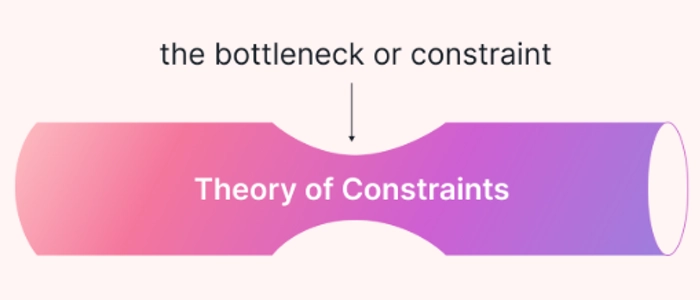
That usually happens when your system has one limiting factor that controls the pace of everything else. In Lean and operations, that limiting factor is called a constraint—and learning to manage it is one of the fastest ways to improve flow.
This is the heart of the Theory of Constraints (TOC): instead of trying to optimize everything, you focus on improving the one thing that’s truly blocking progress.
What is the Theory of Constraints?
The Theory of Constraints is a management approach that says:
Every system has at least one constraint, and improving anything else will have limited impact until that constraint improves.
In simple terms:
- If one step is slower than the rest, it sets the pace for the whole process.
- That slow step becomes the bottleneck.
- TOC helps you identify it and fix it—without wasting effort elsewhere.
Constraint vs bottleneck (are they the same?)
People often use these words interchangeably. A helpful beginner distinction:
- Constraint: the factor that currently limits your system’s output (what truly controls throughput)
- Bottleneck: where work piles up because capacity is lower than demand
In practice, your constraint often shows up as a bottleneck—but not always. The key is to find what is limiting overall results.
If you want a dedicated guide to spotting bottlenecks, read: Bottlenecks: How to Identify and Remove Them.
The 5 focusing steps of TOC (the practical method)
TOC is famous for its simple improvement loop. Here are the five focusing steps in clear, actionable language:
Step 1: Identify the constraint
Find the one place that controls output. Look for:
- Where work items pile up (a growing queue)
- The step everyone waits on (reviews, approvals, a specialist role, a machine)
- The part of the process that is always “busy”
- The handoff that causes the most delays
In Kanban, this becomes very visible when you visualize the workflow and watch where cards get stuck.
Step 2: Exploit the constraint
This means: get the maximum output from the constraint without adding resources.
Practical ways to exploit:
- Remove distractions and unnecessary work from the constraint
- Ensure the constraint always has the right work ready (no starvation)
- Reduce rework by improving input quality
- Batch less at the constraint to keep flow moving
Most teams skip this step and jump straight to hiring or buying tools. Exploiting first is usually the cheapest win.
Step 3: Subordinate everything else
This step is where TOC becomes powerful (and uncomfortable).
Subordinate means: align the rest of the system to support the constraint—even if it makes other areas look less “busy.”
Examples:
- Stop starting new work if it overloads the constraint
- Adjust upstream priorities so the constraint gets the highest-value items
- Prevent non-urgent work from consuming constraint capacity
- Synchronize handoffs so the constraint is not constantly interrupted
In many organizations, people optimize for local efficiency (“my team is busy”) instead of system flow. Subordination flips that mindset.
Step 4: Elevate the constraint
If the constraint is still limiting output after steps 1–3, now you invest in increasing its capacity.
Ways to elevate:
- Add training to create more people who can do the constrained work
- Automate repetitive parts of the constrained step
- Add tools or equipment where it truly increases throughput
- Redesign the process to reduce demand on the constraint
Because you exploited and subordinated first, you now know the investment will actually move the needle.
Step 5: Repeat (the constraint will move)
Once you improve the constraint, a new constraint will appear somewhere else. That’s normal.
TOC is a continuous improvement cycle: identify, improve, and repeat. The goal is not perfection—it’s steady flow improvement.
How TOC shows up in real work
Constraints look different depending on your environment:
- Knowledge work: a specialist reviewer, approvals, QA, deployment windows, unclear requirements
- Manufacturing: a machine with limited capacity, a changeover step, quality inspection
- Project teams: decision-making, dependency on another team, too many projects running at once
The pattern is always the same: one part of the system dictates speed, and everything else must align to it.
TOC + Kanban: a perfect match
Kanban makes TOC easier because it makes constraints visible.
When you visualize work on a board:
- You see where cards pile up (queues)
- You notice where work gets stuck (blocked items)
- You can limit WIP to protect the constraint from overload
- You can track flow metrics to confirm improvement
That’s why TOC and Kanban are often used together: TOC tells you where to focus, and Kanban helps you see and manage the flow.
Quick checklist: how to find your constraint this week
- Pick one workflow (start-to-finish)
- Visualize the steps on a board
- Track where work waits the longest
- Ask: “If we doubled capacity in one step, which step would most improve throughput?”
- Confirm by observing: where do people constantly ask for help or approvals?
If you want deeper bottleneck patterns and fixes, these guides help:
Final Thoughts
The Theory of Constraints is powerful because it’s simple:
Stop trying to improve everything. Improve the one thing that limits everything.
When you identify the constraint and manage work around it, you unlock flow, predictability, and faster delivery—without burning energy on changes that don’t matter.
Related reading: