
What Is Obeya? (Room of Strategy Explained)
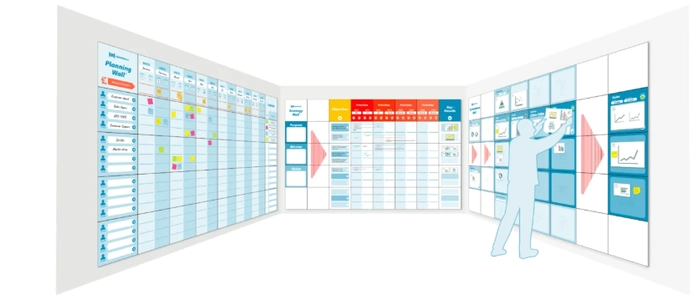
An Obeya is a “big room” where teams align on strategy, priorities, and delivery using clear visual management. It turns hidden work, blockers, and decisions into something everyone can see and act on together.
What “Obeya” means (in plain English)
Obeya (often translated as “big room”) is a Lean practice for running complex work with high visibility and fast alignment. Instead of spreading information across meetings, decks, and scattered tools, Obeya brings the most important information into one visual space so teams can:
- Stay aligned on the few priorities that matter
- See progress and risks early
- Escalate blockers quickly
- Make decisions faster (with the right people present)
What an Obeya is NOT
- Not a “war room” for micromanaging people
- Not a wall of random metrics with no action
- Not just a project status meeting in a different room
An Obeya only works when it drives decisions and actions—not just reporting.
Why teams use Obeya
Obeya is built for situations where work crosses functions and decisions can’t wait:
- Multi-project portfolios
- New product launches
- Operational improvement programs
- Cross-team delivery with dependencies
- Transformation initiatives
If your work frequently gets delayed due to unclear priorities, hidden dependencies, and “waiting for approval,” Obeya is a practical fix.
The 4 core parts of an Obeya room
1) North Star goals and strategy
Start with the outcomes you’re trying to achieve. Keep it simple and visible:
- Primary business goal(s)
- Key targets (quality, delivery, cost, safety, morale—whatever fits)
- Strategy highlights (what you’re doing, and what you’re not doing)
2) Work visualization
This is where the real alignment happens. Visualize active initiatives so teams can instantly see:
- What’s in progress
- What’s blocked
- What’s at risk
- What’s next
3) Problem solving and escalation
Obeya is designed to surface problems early. A simple system works well:
- Top blockers (ranked)
- Owner for each blocker
- Next action + due date
- Escalation path when decisions are needed
4) Cadence (the operating rhythm)
An Obeya is not a one-time setup. It’s a rhythm.
- Daily (10–15 min): quick alignment on flow, blockers, and priorities
- Weekly (30–60 min): deeper review of progress, risks, and decisions
- Monthly/Quarterly: strategy review and goal refresh
How to set up an Obeya in 7 practical steps
Step 1: Define the purpose (one sentence)
Example: “Align teams weekly to deliver Project X on time by surfacing dependencies and removing blockers within 48 hours.”
Step 2: Choose the scope (keep it tight)
Pick one portfolio, one program, or one major initiative first. If you try to visualize everything, you’ll visualize nothing.
Step 3: Identify the “must-attend” roles
Obeya works when decision-makers and doers are present. Include leaders who can remove constraints, plus owners who execute.
Step 4: Build the visual layout (simple beats perfect)
Include:
- Goals: outcomes + targets
- Delivery: initiatives + current status
- Dependencies: what’s waiting on whom
- Blockers: with owner + next action
- Key metrics: only what drives decisions
Step 5: Make WIP visible (Obeya breaks when too much is started)
Obeya is a visibility amplifier—so if WIP is out of control, the room quickly turns into noise. Start with clean WIP measurement using How to Measure Work-in-Progress (WIP) the Right Way.
Step 6: Set explicit WIP limits (so flow improves, not just reporting)
Use a limit at the initiative level (and sometimes per workstream) so teams finish what matters. If you need a tactical guide, use The Ultimate Guide to WIP Limits: Why 3 Is the Magic Number. If you want practical reduction techniques (not theory), use How to Reduce Work in Progress (WIP): Practical Techniques.
Step 7: Run the first 2 weeks as a “learning cycle”
Don’t over-engineer it. Run the rhythm, observe what gets used, and remove anything that doesn’t drive decisions or action.
Obeya in Lean: culture vs tools
Teams often ask: “Is Obeya just another Lean tool?” It can be—but its real power is cultural. Obeya changes behavior by making priorities and problems visible and by building a habit of fast, cross-functional problem solving.
To understand the difference between surface-level Lean tools and real Lean adoption, read Lean Culture vs Lean Tools: What Actually Drives Change. For a bigger picture view of transformation and alignment systems, use The Complete Guide to Lean Transformation.
Obeya vs Kaizen vs Innovation
Obeya is an alignment system. Kaizen is a continuous improvement habit. Innovation is occasionally disruptive. High-performing organizations use all three—but they don’t confuse them.
If you want a simple framing that helps teams choose where to invest their energy, read Kaizen vs Innovation: Why Continuous Beats Occasional.
Common Obeya mistakes (and how to avoid them)
- Too many metrics: keep only metrics that drive decisions
- Status-only meetings: require next actions, owners, and due dates
- No decision-makers present: unresolved blockers pile up
- Too much WIP: the room becomes a list of disappointments
- No cadence: without rhythm, the room becomes decoration
Quick Obeya starter checklist
- We can say the purpose in one sentence
- We have 3–7 priorities (not 30)
- Work is visible with clear owners
- Blockers have an owner + next action + due date
- WIP is measured and limited
- We review on a consistent cadence
Related Articles
- Lean Culture vs Lean Tools: What Actually Drives Change
- Kaizen vs Innovation: Why Continuous Beats Occasional
- The Complete Guide to Lean Transformation
- How to Measure Work-in-Progress (WIP) the Right Way
- The Ultimate Guide to WIP Limits: Why 3 Is the Magic Number
- How to Reduce Work in Progress (WIP): Practical Techniques