
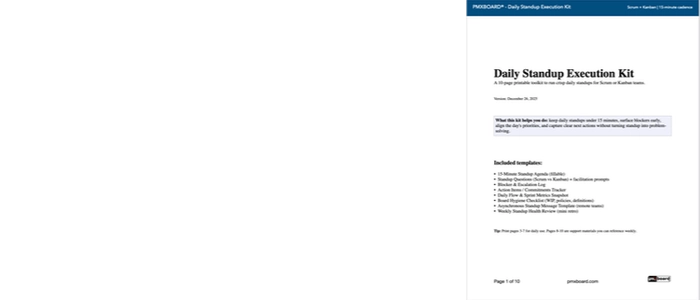
15-Minute Daily Standup Agenda (Scrum + Kanban Format)
A daily standup should be short, consistent, and focused on execution—not status theater. Below is a simple 15-minute daily standup agenda you can run every day, whether your team uses Scrum, Kanban, or a hybrid workflow.
Want a printable version? Get the free PDF toolkit here: Daily Standup Execution Kit (Free PDF)
What this standup agenda is designed to do
This format is built to accomplish three things:
- Align the team: everyone knows what matters today.
- Surface blockers early: issues become visible fast.
- Protect flow: problems get captured and moved to a follow-up—without hijacking the standup.
If your team is still choosing between Scrum and Kanban, these primers may help:
- What Is Scrum? A Complete Beginner’s Overview
- What Is Kanban? A Complete Beginner’s Guide
- Kanban vs Scrum: Which One Should Your Team Use?
The 15-minute daily standup agenda (exact timing)
0:00–2:00 — Start + rules (protect the timebox)
- Start on time: begin even if someone is missing.
- One sentence reminder: “No problem-solving in the standup.”
- Make work visible: open your board (physical or digital).
2:00–12:00 — Updates (choose Scrum prompts or Kanban prompts)
Scrum prompt set (sprint-based)
Use this if your team works in sprints and relies on sprint goals:
- Done: What did I complete since yesterday?
- Next: What will I complete today?
- Blockers: What is blocking me?
Kanban prompt set (flow-based)
Use this if your team manages flow and limits work in progress:
- Closest to Done: What work should we swarm to finish?
- Stuck work: What is blocked or aging and why?
- Flow check: Are we pulling too much or violating WIP limits?
If WIP limits are a recurring pain point, this article is a strong support piece:
What Are WIP Limits? (And Why Most Teams Ignore Them)
12:00–15:00 — Blocker triage (the execution step)
This step is what prevents standups from becoming repetitive. For each blocker, do the following in under 60 seconds:
- Name it: write the blocker in a blocker log (don’t rely on memory).
- Assign an owner: one person accountable.
- Define next step: one clear action.
- Set a deadline: “by today 2pm” is better than “ASAP.”
- Schedule follow-up: immediate huddle or async thread.
After-standup follow-up (keep it short)
The standup is for surfacing issues—not solving them. The fix is a short follow-up huddle with only the right people.
- Who joins: only the people needed to resolve the blocker.
- How long: 10–15 minutes max.
- Outcome: a decision, a workaround, or an escalation step.
For more on how to run standups without wasting time, cross-reference this published article:
Daily Standups: How to Run Daily Meetings That Don’t Waste Time
Standup rules that keep the meeting healthy
- One speaker at a time: no side conversations.
- No solutioning: capture the issue and move it to follow-up.
- Keep updates work-based: talk about work items, not vague “busy-ness.”
- End with clarity: every blocker has an owner + next step.
FAQ
How long should a daily standup be?
10–15 minutes is ideal for most teams. The meeting should protect focus and flow—not consume it.
Is the daily standup only for Scrum teams?
No. Kanban teams use standups too—often with better flow prompts focused on finishing work and reducing blockers.
What if our team is remote or hybrid?
Use the same structure, but consider adding an async backup. The free kit includes an async standup template for remote teams.
Get the free Daily Standup Execution Kit (PDF)
If you want this agenda in a printable format with a blocker log, escalation workflow, and action tracker, download the toolkit here: