
Kaizen Metrics: What You Should Track (and Ignore)
Kaizen only works long-term when teams can see results and learn from them. The right Kaizen metrics help you prove impact, guide the next improvement, and build momentum—without turning improvement into spreadsheet theater.
The purpose of Kaizen metrics (what they’re actually for)
Kaizen metrics are not about policing people. They exist to answer three practical questions:
- Did the improvement work?
- Where is the next bottleneck or waste?
- What should we do next?
If your metrics don’t change decisions or actions, they’re noise.
Start with outcomes, not activity
A common mistake is measuring Kaizen activity (“how many ideas did we collect?”) instead of Kaizen outcomes (“what improved?”). Activity metrics can be useful, but only as a secondary signal.
The best Kaizen metrics connect to real outcomes such as:
- Delivery: faster completion, fewer delays
- Quality: fewer defects, less rework
- Cost: less waste, fewer errors, fewer handoffs
- Safety: reduced risk, fewer incidents
- Morale: less firefighting, clearer work, fewer frustrations
The 10 Kaizen metrics worth tracking
You don’t need all of these at once. Choose 3–5 that match your improvement goal.
1) Lead time (customer waiting time)
If your Kaizen target is faster delivery, lead time is the most direct metric. Track it from “Ready” to “Done” (or your equivalent definition).
2) Cycle time (time to do the work)
If your goal is improving how work is performed, cycle time shows whether the actual work is getting faster or smoother.
3) Work-in-progress (WIP)
High WIP creates delay and context switching. Many Kaizen wins come from reducing WIP, tightening intake, and finishing before starting.
4) Throughput (completed items per period)
Throughput helps you see whether improvements increase output without adding headcount. Use it alongside lead time to avoid “more output, but slower service.”
5) First-pass quality (FPQ)
Measure how often work passes review/inspection the first time. Kaizen often reduces rework by improving clarity, checklists, and standard work.
6) Rework rate
Track how often items bounce backward (e.g., Review → In Progress). If rework drops after a Kaizen change, you’re building a more reliable process.
7) Defects / errors per unit
For operations and service processes, a basic error rate metric is powerful and easy to understand.
8) Time lost to searching / handoffs
Many office Kaizen wins reduce searching and “where is that?” delays. Track a simple before/after estimate based on observation and repeated sampling.
9) Blocker frequency + blocker age
Count how often work becomes blocked and how long blocks persist. If blocks shorten, flow improves even if output stays the same.
10) Adoption / standard work compliance (light-touch)
If you improved a process, track whether the new method is being used. Keep this light: quick audits or sampling beats heavy policing.
Kaizen metrics you should ignore (or de-prioritize)
These metrics often create pressure and distortion without improving the system:
- Vanity activity counts (ideas submitted, meetings held) with no outcome link
- Individual utilization (“how busy is everyone?”) instead of flow metrics
- Too many KPIs at once (teams stop trusting or using the numbers)
- Single-number scoreboards that hide tradeoffs (speed vs quality)
- Monthly-only measurement when your process changes weekly
How to pick the right Kaizen metrics (simple decision rule)
Use this quick mapping:
- Goal: faster delivery → lead time, WIP, blocker age
- Goal: better quality → first-pass quality, defects, rework rate
- Goal: less chaos → WIP, blocker frequency, lead time variation
- Goal: lower cost → rework rate, errors, time lost to searching/handoffs
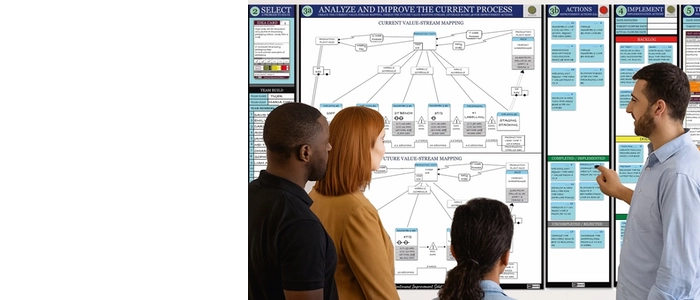
Make Kaizen metrics “visual” so teams actually use them
Kaizen metrics should be easy to see and discuss where the work happens—otherwise they become reporting artifacts.
A simple Kaizen metric board layout
- Before: baseline metric(s)
- After: current metric(s)
- Change: what we improved and why it should work
- Result: impact and next step
This turns metrics into learning, not judgment.
How metrics connect to Lean culture (so improvement sticks)
Kaizen metrics only help when culture supports learning. If teams fear punishment, they’ll hide problems and game the numbers.
To understand the difference between surface-level tools and real, sustained improvement behavior, read Lean Culture vs Lean Tools: What Actually Drives Change.
Kaizen vs Lean vs “big transformation” metrics
Kaizen metrics should be close to the work and improvement-friendly. Broader Lean transformation metrics can exist, but they should not replace local learning metrics.
For a simple explanation of how Kaizen fits within Lean, read Kaizen vs Lean: What’s the Difference?. For a bigger picture perspective on transformation and how measurement supports it, use The Complete Guide to Lean Transformation.
Kaizen metrics vs innovation metrics
Kaizen is continuous improvement—small, steady gains. Innovation is occasional, often disruptive change. Measuring them the same way causes confusion.
If your team debates whether it should “innovate more” versus improve daily execution, use Kaizen vs Innovation: Why Continuous Beats Occasional to frame the difference clearly.
A practical 4-week Kaizen measurement plan
- Week 1: choose 3–5 metrics tied to the improvement goal and capture baseline
- Week 2: implement the change and measure daily/weekly (simple sampling is fine)
- Week 3: stabilize (standardize what works, remove what doesn’t)
- Week 4: compare baseline vs current, publish results, pick the next bottleneck