In today’s fast-paced business environment, efficiency and continuous improvement aren’t just buzzwords
— they’re what separates thriving companies from struggling ones.
Whether you’re managing a growing team, trying to streamline complex workflows, or simply looking for a smarter way to get things done, visual management tools like Kanban and Kaizen can be genuine game-changers.
But how do you know which one fits your organization best? Let’s take a closer look at both methods, their key differences, and how to choose the right approach for your goals.
“Without standards, there can be no improvement.”
— Taiichi Ohno
Understanding Kanban: A Visual System for Smarter Workflows
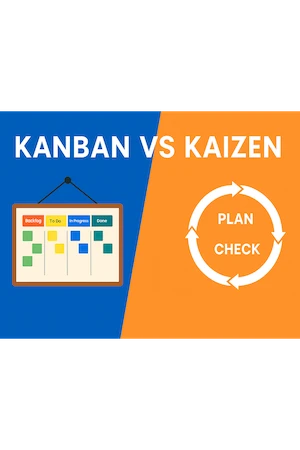
Kanban is a visual workflow management method that helps teams work more efficiently by limiting what’s in progress, improving flow, and spotting bottlenecks early.
Originally developed within Toyota’s Lean Manufacturing system, Kanban has since evolved into one of the most widely adopted approaches in project management, software development, and operations.
Core Principles of Kanban
-
Visualize the work – A Kanban board displays every task, giving instant visibility into what’s being worked on and what’s next.
-
Limit work-in-progress (WIP) – Teams set boundaries on how many tasks can be active at once to avoid overload.
-
Manage flow – Monitoring how tasks move through each stage helps identify and resolve slowdowns quickly.
-
Establish clear policies – Defined rules ensure consistency and accountability.
-
Continuously improve – Teams regularly review progress and refine how they work.
Benefits of Kanban
-
Boosts transparency and team collaboration.
-
Reduces multitasking and task switching.
-
Eliminates workflow bottlenecks.
-
Highly flexible — fits a wide range of industries and team sizes.
Understanding Kaizen: Building a Culture of Continuous Improvement
Kaizen isn’t a tool — it’s a mindset.
It’s the belief that small, consistent improvements over time lead to big, lasting results.
Rooted in Lean and Six Sigma principles, Kaizen promotes a company-wide culture where everyone contributes to making processes better, faster, and more efficient.
Core Principles of Kaizen
-
Eliminate waste (Muda) – Identify inefficiencies and remove anything that doesn’t add value.
-
Empower employees – Everyone, from management to the front line, takes part in improvement efforts.
-
Standardize best practices – Maintain structure and consistency in how work gets done.
-
Follow the PDCA cycle (Plan–Do–Check–Act) – A simple framework for continuous refinement.
-
Use data for decisions – Measure performance and use real metrics to drive change.
Benefits of Kaizen
-
Encourages a proactive improvement mindset.
-
Reduces operational waste and costs.
-
Improves morale and engagement through team ownership.
-
Drives long-term growth and sustainable performance.
Kanban vs. Kaizen: Key Differences at a Glance
| Factor | Kanban | Kaizen |
|---|---|---|
| Focus | Workflow efficiency | Continuous process improvement |
| Approach | Visual task management | Cultural and philosophical mindset |
| Implementation | Uses boards, WIP limits, flow tracking | Uses small, consistent process changes |
| Best for | Agile teams, project management, manufacturing | Organizations aiming for cultural transformation |
| Timeframe | Real-time and ongoing | Long-term, iterative growth |
Although they differ in focus, Kanban and Kaizen complement each other perfectly. Many high-performing teams actually use both — Kanban to visualize work and Kaizen to keep improving it.
Which Method Is Right for You?
-
If you want to visualize tasks, manage workflows, and boost day-to-day efficiency, Kanban is your go-to system.
-
If you’re focused on developing a culture of ongoing improvement and reducing waste, Kaizen is a better fit.
-
And if you want the best of both worlds, combining Kanban’s visual clarity with Kaizen’s improvement mindset can completely transform how your organization operates.
Final Thoughts
Both Kanban and Kaizen are proven approaches to making work more structured, efficient, and fulfilling.
Kanban brings clarity and control to how teams execute projects, while Kaizen instills a long-term mindset of progress and innovation.
At PMXBOARD, we design visual productivity systems that help teams apply both methodologies effectively. From Kanban Boards that simplify task management to Kaizen Board Sets that guide improvement workshops, our modular magnetic systems make continuous progress visible — and achievable.
Want to see what a Kaizen board looks like in practice? Read What Is a Kaizen Board? for the zones, card fields and two worked examples.
Explore our full range of visual management tools at PMXBOARD.com and see how you can take your workflow efficiency to the next level.
Have you reviewed our unique Kanban Boards? Review the category by clicking here. And a few specific products we recommend you to take a look for Kanban Boards;
Agile Management Board Set, Full Kanban Set. Click here to review it.
Desktop Kanban Board Set, Full Agile Kit. Click here to review the Desk Kanban Board Set.
Flexible Kanban Board Sets from 3 columns to 4 and 6 column solutions to meet your need. Click here to review it.
Here is our unique Kaizen Board Sets, review the category by clicking here. And a few specific products we recommend you to take a look for Kaizen Boards;
Full Kaizen Board Set, the most comprehensive Kaizen Board Set from start to finish! Click here to review it.