A physical Kanban board does one job better than any screen: it keeps work visible to everyone in the room, all day, without anyone opening a tab. Most teams start with a spare whiteboard and sticky notes, and that is where most boards fail: the notes curl, the columns get redrawn, and nobody updates the board.
This guide compares PMXBOARD's magnetic boards by team size, wall space, columns, and what comes in the box, so you can choose a board your team will keep using.
Prices and specs were taken from the live PMXBOARD product pages on October 3, 2026. Confirm on the product page before you order.
Quick answer: which physical Kanban board should you buy?
- A team of 4–10 people sharing a wall: Kanban Whiteboard Kit. 42" × 23" magnetic board with 84 magnetic cards, $318.
- A team that wants a free-standing easel and more cards: Scrum Board Combo Set. 42" × 23" board, 139 magnetic cards and a wood easel, $384.
- Limited wall space, frequent moves, or a rented office: Flex Set. A rollable board in 3, 4, or 6 columns with cards, from $114.
- You already own magnetic cards: Flex Board Only. The same rollable board without a card set, from $59.
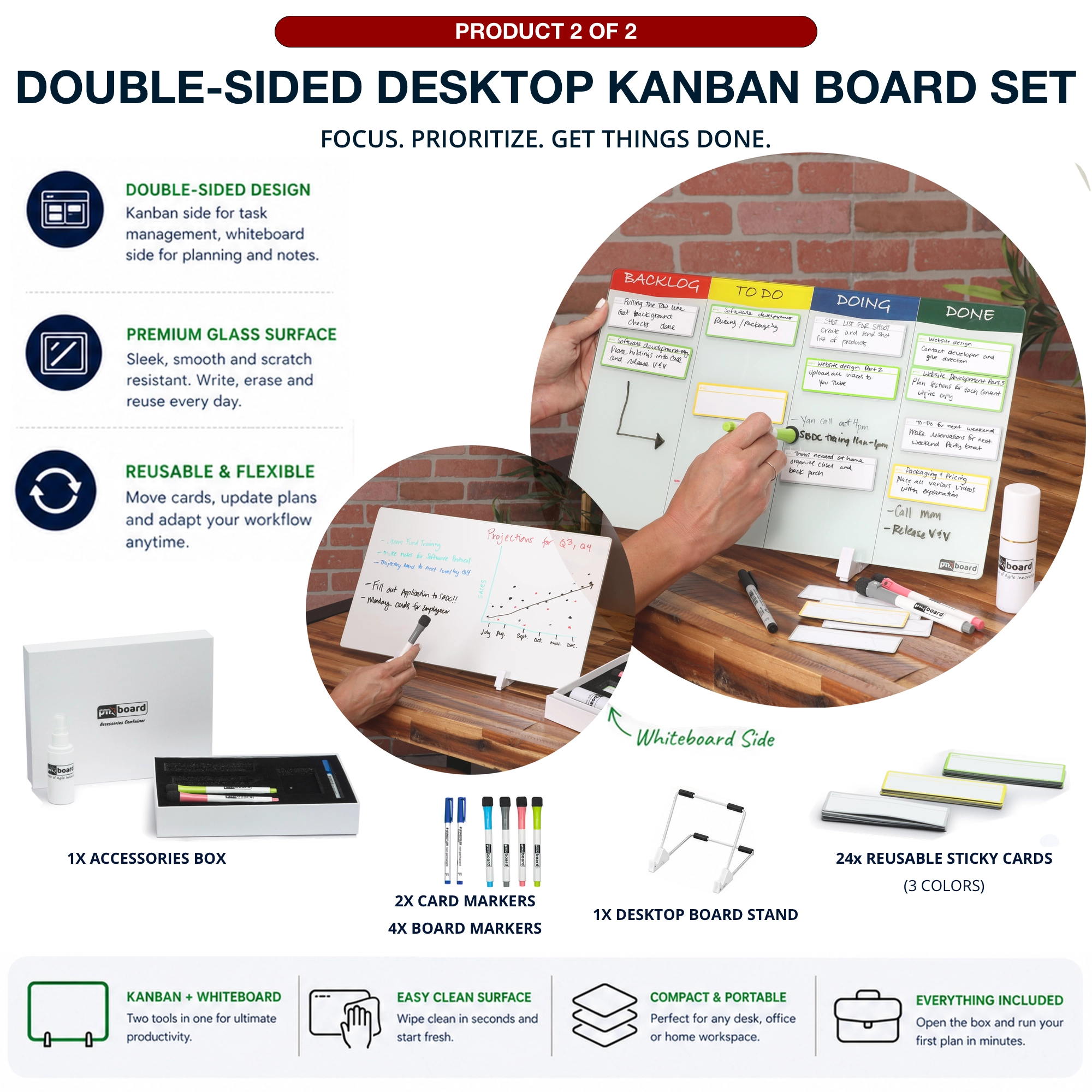
- One person, one desk: Desktop Kanban Board. Dual-sided board with 24 reusable cards and a stand, $98.
- A team board plus a personal board: 2-in-1 Kanban Board Set. A 23" × 42" wall board and an 11" × 18" desktop board, $374.
Side-by-side comparison
| Board | Board size | Columns | What's included (per live product page) | Price | Best for |
|---|---|---|---|---|---|
| Kanban Whiteboard Kit | 42" × 23" | Predefined Kanban/Scrum column headings plus blank headline cards for custom columns | 84 magnetic cards and status indicators; card and board markers; cleaning supplies; installation accessories | $318 | Co-located team, one shared wall |
| Scrum Board Combo Set | 42" × 23" | 4 blank headline cards (custom columns) | 100 task, 25 detail, 10 blocker and 4 headline magnetic cards; 3 card markers; 4 board markers; wood easel | $384 | Scrum teams, large backlog, easel setup |
| Flex Set | 29.5" × 23.1" / 39.3" × 23.1" / 58.26" × 26.6" | 3 / 4 / 6 | Magnetic cards (36 / 48 / 84 task cards plus headline, detail and blocker cards); 2 card markers; 4 board markers; cleaning set; mounting accessories; tube or box | $114 / $147 / $238 | Small rooms, travel, trainers |
| Flex Board Only | Same three sizes | 3 / 4 / 6 | Board; 4 board markers; cleaning set; mounting accessories; tube or box. No cards | $59 / $87 / $149 | You already own magnetic cards |
| Desktop Kanban Board | Compact desktop size | 4 (Backlog, To Do, Doing, Done) + blank dry-erase side | 24 reusable magnetic task cards; flip-and-rotate stand | $98 | One person at one desk |
| 2-in-1 Kanban Board Set | 23" × 42" wall + 11" × 18" desktop | Backlog / To Do / Doing / Done; customizable | 84 magnetic cards; 24 reusable sticky Kanban cards; 2 card markers; 4 board markers; wood easel; desktop stand; cleaning set; accessories box | $374 | Team lead: team wall plus personal desk |
What to look for in a physical Kanban board
1. A size that fits your team and your wall
The board should hold every item in progress, plus a visible backlog, without cards overlapping. As a rough guide, a 3-column board (29.5" × 23.1") suits one person or a pair, and a 4-column board (39.3" × 23.1") suits a small team's daily standup. Wall boards at 42" × 23", and the 6-column Flex at 58.26" × 26.6", give a whole team or department room to work. Measure the wall, but also the floor in front of it. Everyone needs space to stand at the board for a 15-minute standup.
2. Columns you can change
The classic flow is To Do, Doing, Done. Many teams add Review, Testing, or Blocked once they see where work waits. If your process is still settling, choose a board whose column headers are magnets you can relabel, not lines you have to redraw:
- Each Flex Set includes one blank magnetic headline card per column.
- The Combo Set includes four.
- The Kanban Whiteboard Kit comes with predefined column headings plus blank headline cards for custom labels.
3. Reusable magnetic cards instead of sticky notes
Sticky notes lose their grip on a vertical board. Reusable magnetic cards stay put and wipe clean. Count the cards: you want enough for current work, a backlog, and a few blockers.
- 3-column Flex Set: 36 task cards.
- 6-column Flex Set: 84 task cards.
- Kanban Whiteboard Kit: 84 magnetic cards and status indicators.
- Combo Set: 100 task cards, 25 detail cards, 10 blocker cards, and 4 headline cards.
4. Mounting: wall, easel, or desk
Decide where the board will live before you buy:
- The Combo Set and the 2-in-1 Set each include a wood easel, so the board can stand in a meeting room or move between rooms.
- The Kanban Whiteboard Kit supports wall hanging, an easel or stand, or attaching to any magnetic surface.
- The Flex boards are thin and rollable, come with mounting accessories, and ship in a protective tube or box.
- The Desktop board has its own stand.
5. A real dry-erase surface
Every board in this guide has a magnetic dry-erase surface, so you can write WIP limits, a sprint goal, or swimlane labels directly on it. The Flex sets, Flex boards, Combo Set, and 2-in-1 Set each list four board markers (2 mm tips). The Kit lists card and board markers without a count.
The boards, one by one
Kanban Whiteboard Kit: the default team wall board ($318)
The Kanban Whiteboard Kit is a 42" × 23" magnetic board with 84 magnetic cards and status indicators, including task, detail, blocker, and headline cards. It also comes with card and board markers, cleaning supplies, and installation accessories. The product page lists its weight as about 6 lbs. Choose it if your team stands up at the same wall every morning and wants everything in one box.
Scrum Board Combo Set: an easel and the most cards ($384)
The Scrum Board Combo Set pairs a 42" × 23" dry-erase board with 100 task cards, 25 detail cards, 10 blocker cards, 4 blank headline cards, 3 card markers, 4 board markers, and a wood easel stand. It suits Scrum teams with a large sprint backlog, or any team that needs the board on an easel rather than a wall.
Flex Set: rollable boards in 3, 4, or 6 columns ($114 / $147 / $238)
The Flex Set is an ultra-thin magnetic dry-erase board that rolls up for storage or travel. Each size comes with its own card set:
| Size | Board | Price | Task cards | Detail cards | Blocker cards |
|---|---|---|---|---|---|
| 3-column | 29.5" × 23.1" | $114 | 36 | 4 | 4 |
| 4-column | 39.3" × 23.1" | $147 | 48 | 6 | 6 |
| 6-column | 58.26" × 26.6" | $238 | 84 | 8 | 8 |
Every size also includes headline cards, markers, a cleaning set, and mounting accessories. It is a good magnetic Kanban board for coaches, trainers, and teams that change rooms.
Flex Board Only: when you already have cards ($59 / $87 / $149)
The Flex Board Only uses the same three sizes and the same rollable magnetic dry-erase surface, but no card set. You get the board, 4 board markers, cleaning accessories, mounting accessories, and a storage tube or box. Choose it if you already own magnetic cards, or if your team prefers to write directly on the board.
Desktop Kanban Board: a personal board for one desk ($98)
The Desktop Kanban Board is dual-sided. One side is a Kanban layout (Backlog, To Do, Doing, Done) and the other is a blank dry-erase surface. It comes with 24 reusable task cards and a stand you can flip between the two sides. It is built for one person: remote workers, project managers tracking their own follow-ups, or a team member keeping a personal sprint list next to the team board.
2-in-1 Kanban Board Set: plan big, execute daily ($374)
The 2-in-1 Set combines both formats in one box:
- A 23" × 42" magnetic wall board with 84 magnetic cards and a wood easel.
- An 11" × 18" double-sided desktop board with 24 reusable sticky Kanban cards and a desktop stand.
- 2 card markers, 4 board markers, a cleaning set, and an accessories box.
Use it when a team lead wants the big picture on the wall and their own priorities on the desk.
When a physical board is the wrong choice
A physical board is the right tool when the people doing the work share a room at least part of the week. It is the wrong tool if nobody on the team is ever in the same place, or if you need an automatic audit trail of every change. Many teams use both: the board runs the standup and their existing tool keeps the record. Still deciding? Read physical vs digital boards first.
Setting up your board in the first week
- Map three to five columns that match how work really moves, not how you wish it moved.
- Write a WIP limit above your Doing column. Start low; why three is often enough.
- Put every active task on a card. If it is not on the board, it does not exist.
- Stand at the board daily for 15 minutes. Use a simple daily standup agenda.
- Review after two weeks. Rename, add, or remove columns with the headline magnets.
For a full walkthrough, see how to build a Kanban board step by step.
Frequently asked questions
What size physical Kanban board do I need?
One person: a desktop board or 3-column Flex. Small team: a 4-column Flex or a 42" × 23" wall board. Larger teams or departments: the 6-column Flex (58.26" × 26.6").
Is a magnetic Kanban board better than sticky notes on a whiteboard?
For a board you will use every day, usually yes. Magnetic cards don't lose adhesion, you can reuse them indefinitely, and you can move them without tearing. Sticky notes are fine for a one-off workshop.
Can I use the whiteboard I already have?
Yes. If your whiteboard is magnetic, add a set of Agile magnetic cards and draw or label your columns. If you already have cards but need a board, the Flex Board Only is the lowest-cost option.
How many columns should a Kanban board have?
Start with three (To Do, Doing, Done) and add a column only when you see work waiting in a specific stage, such as Review or Testing. Most team boards settle at four to six columns.
What is the difference between a Kanban board and a Scrum board?
On a physical board, the hardware is the same. A Scrum board resets every sprint around a sprint backlog. A Kanban board runs continuously with WIP limits. Any agile task board in this guide can be used either way. See Kanban vs Scrum for help choosing.
Ready to choose? Browse all Agile board sets.