
What Is Takt Time? The Simplest Explanation
Takt time is the pace you need to complete work to meet customer demand. If you can match that pace consistently, you avoid overload, delays, and constant firefighting.
Takt time in one sentence
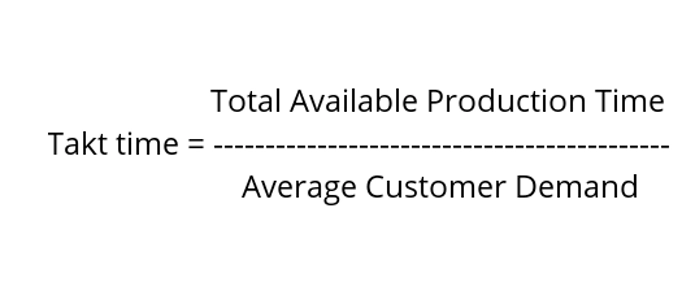
Takt time = Available working time ÷ Customer demand
It tells you how often you must finish one unit (or one request) to keep up with what customers need.
A simple takt time example
Let’s say your team has 7.5 hours of working time per day (450 minutes) and customers need 90 units per day.
- Available time: 450 minutes/day
- Demand: 90 units/day
- Takt time: 450 ÷ 90 = 5 minutes per unit
That means, on average, you need to complete one unit every 5 minutes to meet demand.
What takt time is NOT
Takt time is often confused with other time measures. Here’s the clean separation:
- Takt time: the required pace based on demand
- Cycle time: how long it takes to complete one unit of work when you’re actively working on it
- Lead time: how long the customer waits from request to delivery
If you want a beginner-friendly definition of cycle time before you go deeper, start with What Is Cycle Time? (Beginner Lean Guide).
Why takt time matters
Takt time is useful because it turns “we’re busy” into a measurable pacing target. When you know takt time, you can:
- Set realistic daily/weekly production or delivery targets
- Identify when you’re over capacity (demand is higher than you can produce)
- Design staffing, scheduling, and work methods around a clear pace
- Reduce chaos by stabilizing work flow
How to use takt time in real life
Takt time is easiest to apply when you treat it as a planning tool—not a stopwatch. Here’s a practical approach:
1) Define your “unit” and your “customer”
In manufacturing, a unit might be a part or product. In an office or knowledge team, a unit could be:
- a processed order
- a completed service request
- a reviewed document
- a resolved ticket
Then define “customer demand” as how many units are needed in a time period (day/week).
2) Calculate available time (the honest version)
Available time is not the length of a shift. Subtract what isn’t usable:
- breaks and planned meetings
- mandatory training
- handoffs and startup/shutdown time
The goal is a realistic number you can actually plan with.
3) Compare takt time vs your cycle time
This is where takt time becomes powerful:
- If your cycle time is faster than takt time, you can meet demand (assuming flow is stable).
- If your cycle time is slower than takt time, you will fall behind unless you improve the process, add capacity, or reduce demand.
What to do when you can’t meet takt time
If demand requires a pace you can’t sustain, you have a few options:
- Reduce waste so cycle time drops
- Improve flow so work doesn’t sit waiting
- Standardize the process so performance is repeatable
- Add capacity (people, equipment, hours)
- Level demand to avoid spikes and starvation
Connect takt time to standard work and 5S
Takt time is a target pace. To consistently hit that pace, your process needs stability.
That’s where standard work helps: it documents the best-known method so results are repeatable. Use Standard Work: How to Create Reliable Processes to create consistency that supports takt-based planning.
And if your workspace is cluttered, searching for tools and information quietly destroys your ability to keep pace. Apply 5S to remove friction using What Is 5S? Lean Workplace Organization Guide and the knowledge-work examples in 5S in Offices: Practical Examples for Knowledge Teams.
Takt time and customer waiting (lead time)
Even if you can “produce” at takt, customers may still wait too long if work sits in queues or gets stuck in approvals. That’s lead time—and it matters just as much.
To reduce customer waiting, use How to Reduce Lead Time in Knowledge Work. If you want a quick clarification on the difference between internal waiting and customer-facing delay, read What Is Lead Time vs Lag Time? (Easy Explanation).
Common takt time mistakes (and how to avoid them)
- Using shift length as “available time”: subtract breaks/meetings or your takt will be fantasy
- Changing the unit midstream: define the unit clearly (one order, one ticket, one part)
- Ignoring variation: takt is an average pace—expect some fluctuation and plan buffers
- Forcing people to “work to takt”: use takt to improve the system, not to pressure individuals
- Not stabilizing the process: without standard work and 5S, takt targets won’t hold
Quick takeaway
Takt time is simply the pace required to meet demand. It becomes useful when you combine it with stable processes (standard work), low-friction workspaces (5S), and flow thinking (lead time and cycle time).